

At Forty-One, I Became a Beginner Again. It Was Worse Than I Expected.
Experience doesn't make beginning easier. It raises the price of failing.

Publish Day. 4:47 AM. My brain has been looping all night, parsing out the various scenarios of catastrophe that might happen in several hours when my very first Substack article launches. I toss and turn. I drift back to sleep. 6:07 AM, I give up and start my day. 7:00 AM, the post goes out. 7:08, I check the numbers. 7:33, I refresh. 7:47, I refresh again. I refreshed that screen at least 87 more times that morning, each time looking for the simple reassurance, “Am I OK?”
I’ve built and sold a company before. I’ve endured an M&A process in a down market. I’ve spoken on stages in front of thousands. I’ve even given a company address in a foreign language. I’m not a stranger to scary, hard, and public ventures. Truthfully, these seemingly hard things weren’t even that hard. I practiced, got up to bat, and swung. Publishing a newsletter though? The stakes felt like I was walking into the Hunger Games arena. Disproportionate? Clearly.
Logic tells us that lived experience should make beginnings easier. And mostly, logic is right. Miss your numbers once because of a broken formula in the forecast doc, and you rebuild the model with error checks. Make one wrong hire, and you rebuild your entire hiring process. The next mistake is a different one. I am a hypervigilant spreadsheet type. My experience has, almost every time, made the next thing easier. That is how we progress on a linear path.
True beginnings, though, are non-linear. Most of the time, beginnings are just continuations with different branding. The reason I was able to raise millions in venture capital as a first-time founder in just 23 days? I had spent my earlier career in business development, getting to yes was the job. Or the company address I gave in French. I’m not fluent, but je me débrouille (I get by). In a boutique in Marrakech I once told a shopkeeper in French that I loved his horse oil when I meant to say his hair oil, a single vowel off. But give me 72 hours and I can memorize a speech in French the same way I can in English. All I had to do was practice, and I have twenty-five years of practicing speeches.
Writing, on the other hand, particularly personal essays, is something I’m entirely new at. Emails and board memos are a genre, but nobody has ever told me a board memo made them rethink their life path.
Writing LinkedIn posts on fundraising and acquisition wins that earned me a LinkedIn Top Voice only enhanced my external persona. Writing about how fire ceremonies and moon water rituals enhance my ability to lead companies is not only a new skill, it comes with a cost in the business world where I still operate. A recruiter once passed on me for a CEO role at a PE-backed company because they wanted someone who was “more of a CEO.” I was a CEO. That was before I started publishing anything about fire ceremonies.
Experience doesn’t make a true beginning easier. It only raises the price of failing at one.
This is not another guide to growth. There are far too many of those already on the market. This is a post for people getting off a linear path: the career change at forty-eight with two kids, moving to a foreign country where you don’t speak the language, going from W-2 to 1099 and being responsible for hunting new business. These are some frameworks that helped me show up at the starting line and keep coming back as a new beginner.
The conversation with your eighty-year-old self
There is only one person in this world I worry about disappointing, and that is eighty-year-old Nathalie.
In the present tense, it’s easy to be overwhelmed by excuses. I run a company. I have a rambunctious six-year-old. My body carries an exhaustion it didn’t carry fifteen years ago. On paper, I don’t have the space to begin again.
So I stopped asking myself at forty-one. My practice involves sitting down, meditating, and asking my eighty-year-old self whether we did everything we wanted to in this lifetime. If she says no, we had this idea and never made time for it, then I have my signal. We find a way.
At twenty-one, I started writing a travel blog, “A Girl and Her Luggage.” I wanted to be an editor at Travel & Leisure. I had just written up a visit to The Rockhouse Hotel in Negril. I never hit publish. My eighty-year-old keeps bringing this up. It’s been twenty years.
Failing is freeing
My worst fear is putting my ideas into the world and being irrelevant. As a LinkedIn Top Voice, I’ve gotten some experience with putting myself out there, but it also means I know what works, and I keep running the same successful formula. My best posts reach 40K impressions.
A month into writing Spreadsheets and Shamans, I posted about intuition and spreadsheets, far from my standard formula. It was four hours before anyone liked it, and it was a phone-a-friend situation. 48 hours later it hadn’t cleared 700 impressions, and it finished with 4 likes.
I am deep in the world of spreadsheets, always measuring campaigns and A/B tests. I read data as a sign of relevance. By every measure available to me, this post was irrelevant. My fear came to life. I was irrelevant.
And nothing happened to me.
I spent twelve hours steeped in anxiety over an outcome that turned out to be inconsequential. I never got the reassurance I’d been refreshing for. I was OK anyway.
Commit publicly, build safeguards
The vision for this Substack came to me in Mexico, on spring break, away from my real job, with ample space to ponder, while sitting by the pool. I had been meditating and poof, the idea arrived. I wrote “Spreadsheets and Shamans” in my journal. Years of stories I had been sitting on but hadn’t known how to tell spilled onto the page. I grabbed my laptop from the room and dumped everything onto the screen until it was time to pick up my son from the kids club.
I knew I would get spooked somewhere along the way and want to quit before I gave the idea a real shot. So I built the infrastructure that wouldn’t let me back out. I set a date and I told people about it. Spreadsheets and Shamans was launching June 7th, and the public claim meant I was committed. I set the terms while I was still naive, so I couldn’t back out once I got real information. I wrote six pieces in advance to give myself a buffer. I committed to writing weekly for six months, because much of what you experience in the first few months is noise, and knowing how sensitive my anxiety is to data, good and bad, I needed enough of it before judging an outcome.
That was April. Eleven weeks and eleven posts later, I still have sixteen weeks before I decide what comes next. It’s my protection mechanism against myself.
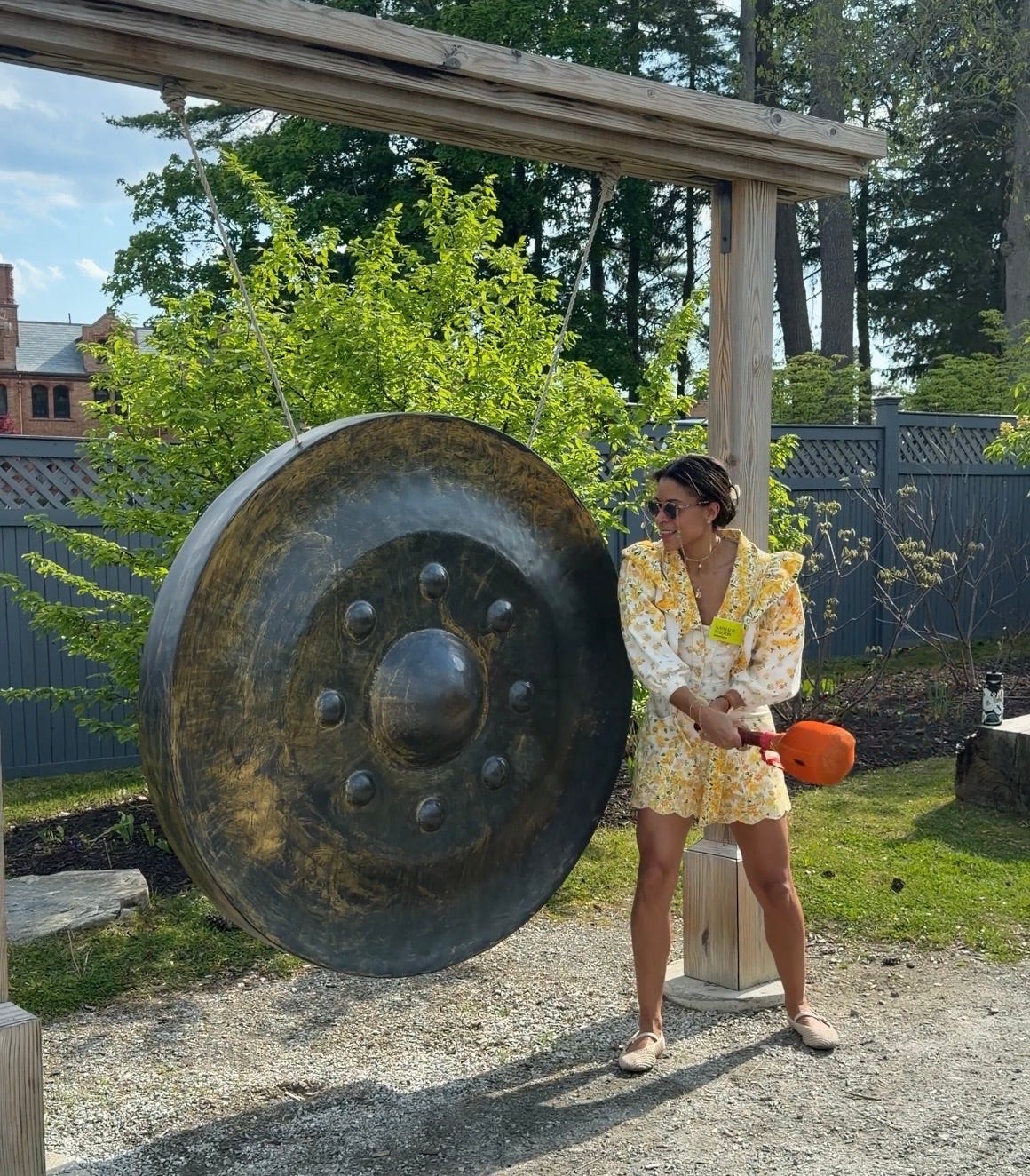
It’s go time!
It’s been a long time since I’ve been a beginner at something. I have three books about writing on my nightstand right now. I have not needed a how-to book since business school.
On three separate occasions I’ve gone searching for an editor. Not because I needed one, but because I am not used to being bad at things and I wanted a professional to confirm I was fixable. I never hired one. Twenty-one-year-olds starting blogs don’t go looking for editors. They don’t yet have a standard to fall short of. I do, and that standard almost cost me the start. This is the price I meant. Experience didn’t make it easier. It made failing cost more.
But the cost I refuse to pay is disappointing eighty-year-old me, who has had this writer’s seed growing in her for twenty years. The linear path was easier and more lucrative. The seed kept growing anyway. My only choice? I had to build the systems that make starting inevitable. For me, that was a conversation with my future self, a failed post with four likes that I keep as evidence, and a system that made failing to show up a bigger crime than showing up poorly. Your system might look entirely different. Just build the system.
There is only one person who cares whether I stop, and that is eighty-year-old Nathalie. One day she will ask whether we did everything we wanted to. She already has. I think about the twenty-one-year-old me with the unpublished travel blog, who has been waiting twenty years to hear this answer.
It’s about damn time.
The Practice
Invite your eighty-year-old self to tea. Pick your favorite tea, mine is Harney & Sons Cinnamon Spice. Do a clearing meditation first, then just chat. Think about the seeds that have been growing in you since you were small, the ones you keep meaning to plant and don’t.
Ask them the one question: Did we do everything we wanted to?
Write down the answer. They will not steer you wrong.
Then write down your excuses. Mine were running a company, a six-year-old, and a body that gets tired earlier than it used to.
Now go build a system that gets you to the starting line anyway.
The Shelf
Graham Weaver’s Stanford GSB last lecture, “How to Live an Asymmetric Life.” His hot take: the voice of fear will lead you to a life that’s too small, and everything you want is on the other side of fear.
The Invitation
What have you been not-starting, and how long has it been?
Mine was twenty years. A travel blog I wrote one post for at twenty-one and never published.
Tell me in the comments or hit reply. I read every one.
Made it this far? Tap the ❤️ so I know it landed. And forward this to someone standing at the beginning of something.
Another winner. Speaks to so many!