


It’s 2021. I’m six months into a startup I joined as a late-stage co-founder and took over as CEO. I open LinkedIn and read an update from a founder I’d been quietly tracking:
“EXCITED TO ANNOUNCE WE JUST GREW REVENUE 225% Month over Month! LFG! 🚀🌙”
I slump into my chair, questioning the investor update I’m about to write. Our stats: month-over-month growth of 23%. Before I opened LinkedIn, I was proud of those numbers. Our team worked to get those numbers. Have I not hustled as hard as this other founder? I send the update anyway, hoping my investor update isn’t the one to disappoint them this month.
In the weeks that followed, this founder kept posting growth rates with no revenue, no starting point, and no denominator. Every loud post of theirs quietly made me feel smaller.
The founder world is small, and a friend of a friend sent an email saying I had to meet the LFG 🚀🌙 founder. They were really crushing it. As I rolled my eyes, I typed: “I am so impressed by this person. I would love the connection.”
I’m good with gracious, so I opened the call with a huge congratulations. 225% growth month over month is impressive. I’ll give credit where credit is due.
“Yeah,” they replied, “it was really awesome to have our first $30K month.”
I finished the math before they finished the sentence. “Incredible,” I said. My shoulders dropped, and I might have let out a sigh.
Their starting point was ten thousand dollars a month if we squinted. I was running a seven-figure business, roughly $100K a month. Ten times their size. For those of you who hate math: their 225% added $22,500. Mine would have had to add $225,000. Same growth rate, different ball game.
None of this is a knock on that founder. The distortion was mine. I assumed a denominator that made their number gold-medal-worthy. What the percentage was actually telling me was how small the starting point was.
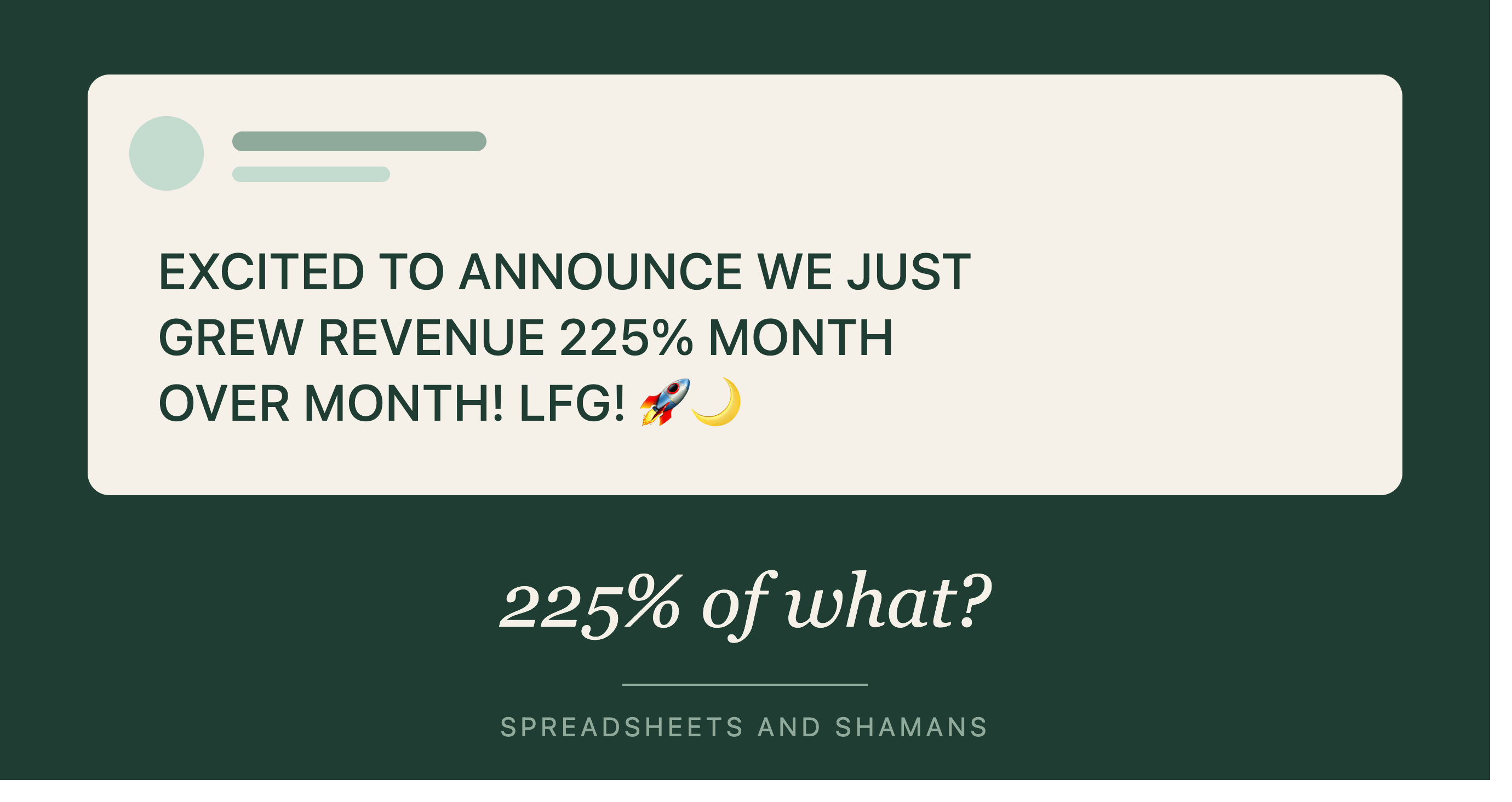
People don’t share their starting points on LinkedIn. They just post the growth story. When everyone posts the same growth stories with no context, it was only natural for me to assume the problem was me.
When you’re a first-time founder there’s so much pressure, but beyond the pressure there’s the constant vigilance, because there’s always something you don’t know. I didn’t know about getting business insurance. I didn’t know how to do a cohort analysis. I didn’t understand the impact of IDFA on a mobile subscription business. So when I saw someone posting that they had grown that quickly, I just assumed it was one more thing I didn’t know. Maybe they had growth hacks I wasn’t privy to. In reality, I did know a lot. I was performing well. But the unknown was so vast that I took it personally.
This isn’t just a founder problem. I do it all the time. During my long, unplanned sabbatical, I saw people lose jobs and find new ones much faster than me. I’d scratch my head and ask myself, why is this so hard for me? They could do it. Why can’t I? What I didn’t see: how long they had been quietly looking, whether they took a massive pay cut, whether they just settled. I’d never have those answers, but that phone call with that founder helped me see this: comparison without the starting point is arithmetically invalid. If we have the wrong inputs, our conclusions will be wrong every time.
So what’s the answer? When I look towards the Shamans for advice, most of what I hear is to stop comparing. “Comparison is the thief of joy.” “Run your own race.” Yes, and that’s a little too passive for me, a certified Spreadsheet who enjoys competing.
My favorite Shaman, Ram Dass, gets more practical. Go into a forest, he says. Some trees are straight, others bent. “You sort of understand that it didn’t get enough light, and so it turned that way.” We don’t hold it against the bent one for growing sideways. It was reaching for what it could get. Then he says, treat people the same way. My version: take people and their LinkedIn announcements exactly as they are.
The trouble with equating trees and people: trees can’t talk. They won’t disclose their starting height, so we can only infer the growth pattern. People can talk. And if you ask them, they often will. On that phone call, the founder handed me the missing part of the denominator, and I was able to discard the comparison entirely.
Before I wrote my investor update, I knew 23% was a good month. It was one of our best. I was proud of it before I opened LinkedIn. Nothing about our number changed. Someone else’s post moved the bar, and I let that make me doubt my own race.
When it comes to the races I’m in, I’ve never stopped comparing. I’m sorry, Shamans, but I compare constantly. Running a company means knowing where I stand against the competition.
I still flinch when I see a social media post with a claim that feels outlandish. What this experience changed is what I do next. I used to ask, “What was wrong with me?” Now I ask, “What’s missing from the equation?”
Most of the time, the problem is the denominator.
The Practice
Pick a number that made you smaller this week. Was it a growth rate, a fundraising announcement, the person who landed a job before you did?
Write it down. Underneath this, write a new line: What I don’t know.
Fill it in. Use your wildest imagination. Anything can be plausible.
It’s likely you will not have most of these answers. That’s the point of this exercise. Look at how much of the equation is blank, then you can decide whether you still trust the conclusion you drew.
The Shelf
Raj Subrameyer’s TEDx talk, “Comparing myself to others saved my life.” The reason to watch this is to understand that comparison isn’t wrong. It can be a helpful tool. The stigma exists because nobody taught us the useful version of comparison.
My hot take: he’s right that “stop comparing” is useless advice, and I’d push further. The problem isn’t your attitude toward the comparison. It’s that you’re going into the assessment with half the inputs missing.
The Invitation
I haven’t stopped comparing.
What comparison are you stuck on? Comments or hit reply. I read every one.
Made it this far? Tap the ❤️ so I know it landed. And forward this to someone still stuck in comparison mode.
This is a reminder to all of about comparing