


Super Bowl champion Russell Wilson grew up with a father who hit him ground balls at 5:30 in the morning, before the rest of the world was awake. And the whole time, his dad drilled him with the same questions over and over. “Why not you? Why not you go pro? Why not you graduate early?” He asked it until Wilson stopped hearing it as a question and started hearing it as a fact.
I sat in front of Wilson last week as he told that story on stage at the Aspen Ideas Festival, on a panel about youth mental health. Wilson sat next to psychiatrists from Mount Sinai who study suicide data and run clinics. Wilson was one of two people on that stage who don’t treat patients, yet he told the ones who do that you can have amazing doctors and nurses, but to treat the youth mental health crisis, you need something “extra” too.
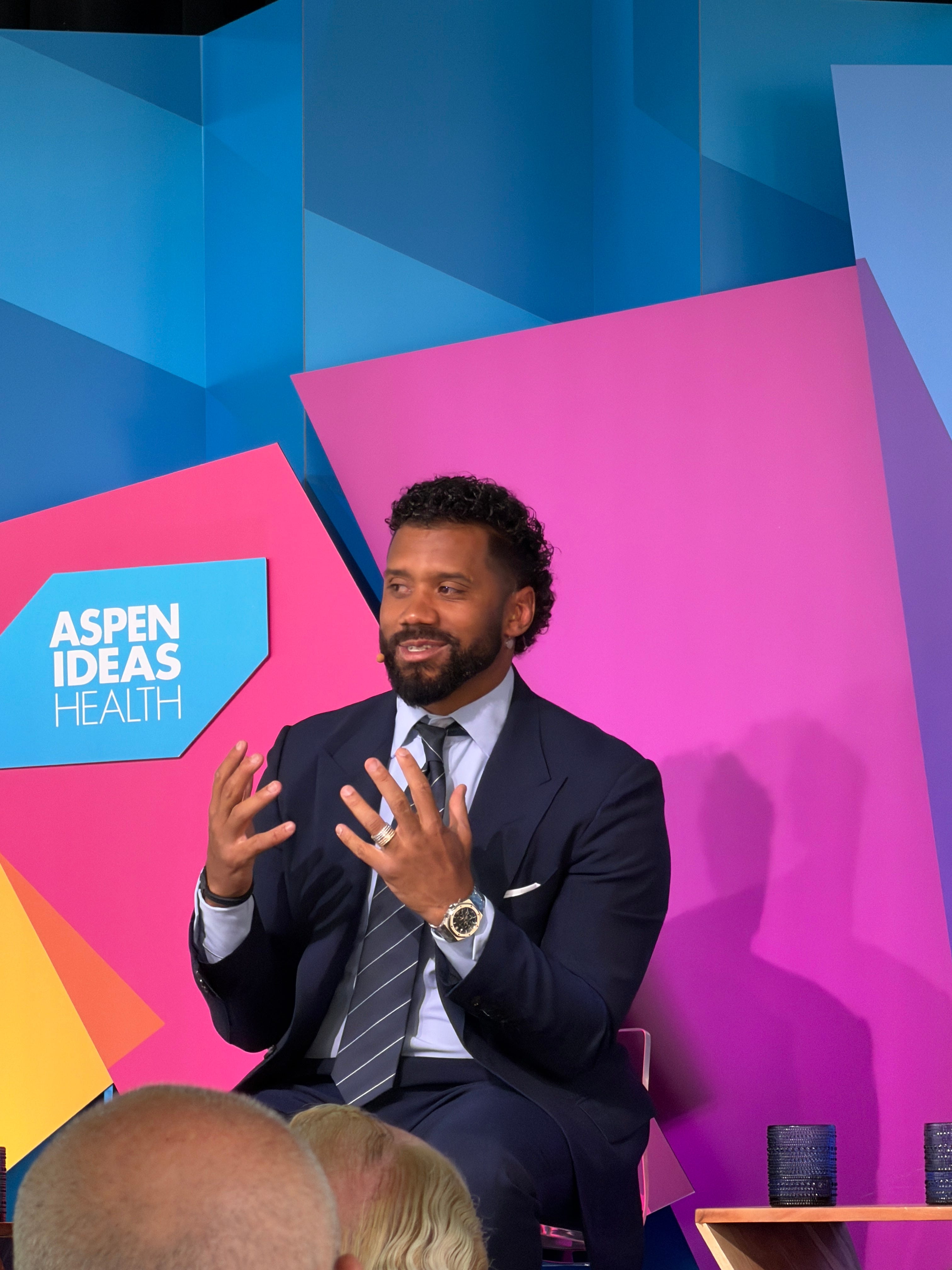
Photo of Russell Wilson from my camera roll at Aspen Ideas: Health
I am a spreadsheet person. I own a P&L. I came to that panel for the data. But I could not disregard what was underneath Wilson’s message. He was telling a room of clinicians that the thing deciding health outcomes was the one thing none of their instruments or tests could measure. It was a belief in themselves, faith, intuition, whatever you want to call it. And I caught myself leaning in.
Around the same time, an ocean away, Oprah was saying her own version of it on a stage at Cannes, with Devi Brown.
“That little feeling you have,” she said, “has led me to this seat. You just have to get still enough to follow it, and most of us can’t, because there is too much noise. Because we keep asking everybody else. Because we ask the world to tell us what it wants for us. It wants your stillness. It wants your reverence. That is the still small voice of your soul, and if you listen to it, you will not be led wrong. Every single time I have gotten myself into trouble, it is because I didn’t.”
“The problem is most of us don’t trust it,” she said. “You think everybody else’s voice is louder than yours.”
Two extraordinary humans. Two of the most credentialed stages on the planet, the same week. A quarterback and a woman who built an empire on connecting with individuals. Neither of them is short on proof that they are excellent at their respective crafts. And both of them, when handed an open mic, skipped the work you would expect them to credit and talked about a feeling: faith, intuition, again, pick your preferred label.
Wilson calls it the something “extra.” Oprah calls it the still small voice.
I can already hear the skeptics… Easy for the Super Bowl winner and the billionaire to credit their gut. That is survivorship bias. For every Russell Wilson who trusted something “extra,” there is a guy who trusted his gut and threw the interception that ended his season.
Fair. So I researched what is actually known about when a gut is worth trusting, because we cannot write permission slips based on two famous people and a nebulous feeling.
Here is the permission slip that is backed by science. The gut they are describing is not the opposite of the work. It is the foundation of it.
Wilson’s something extra sprang to life only after thousands of practice ground balls (and thousands of snaps). Oprah’s still small voice only spoke after decades of reading what a person is not saying. To outsiders, it can seem like these intuitions came out of nowhere, but they were actually the product of thousands of hours of practice.
Here’s the research that backs it up. Daniel Kahneman and Gary Klein spent years disagreeing about intuition but ended up agreeing on exactly when it works. Two conditions. One, the world you are reading has to be predictable enough that there’s a real pattern to learn. Two, you have to have practiced in it long enough, with accurate feedback, to actually learn from it. Meet both, and your gut is a real instrument. Miss either, and all you have is blind confidence, or, as Kahneman refers to it, “the illusion of validity.” The upshot of all this: your gut, under the right conditions, can provide valuable data, but subjective feelings of certainty don’t tell you anything about whether your gut is trustworthy.
So when you have put in the reps, the instinct you cannot fully explain is likely not just an errant feeling. It is pattern recognition outpacing your ability to narrate it. Stop discounting it just because it will not fit in the slide deck. Count it among the data.
By contrast, when you’re working in areas less familiar to you, your gut instinct is less valuable, and should therefore be accorded less weight.
Wilson did not win the Super Bowl because he believed. He won because he could read a defense and believe. Oprah did not build her empire on a feeling. She built it on decades of reading people, and then on a feeling she had earned the right to trust.
This is the whole reason this newsletter exists. Not to tell you to light a candle and wait. To show you that the people operating at the very top of their game are running two instruments at once, the spreadsheet and the something “extra”. Years of interviewing people and thousands of passes. And a feeling they could not diagram.
I have spent twenty years in rooms where it was not safe to show both halves of myself. If you have worked in finance, law, consulting, or anywhere that runs on the spreadsheet alone, you know the specific pain of this. You get to the answer early. You feel it is right before you can defend it. So you sit on it, because the room only speaks one language, and three weeks later the data crawls to the spot you were already standing on and everyone calls it insight.
The silence of holding this cost me something real. It left me believing I was less than the people who could run SQL to arrive at answers. It made me feel like I would never be as good, when the truth was we were playing entirely different games.
I’m done sitting on it. Last week, Oprah and Russell Wilson handed me the permission I have been quietly collecting for years. It is not only okay to be a Spreadsheet and a Shaman. It is what gets you to the top. I hope you take it as your permission slip too. You are more powerful running on both.
Rigor got me into the room. I’m no longer apologizing for the something “extra” that has transformed me into a leader.
The Practice
This week, find the one call you are sitting on. The read you already have but haven’t said out loud, because you can’t defend it yet in the room’s language.
Ask this question:
Have I done real reps here, in a place that gave me honest feedback about whether I was right?
Yes? Stop waiting for the data to catch up. Say the damn thing already.
The Shelf
Gary Klein, Sources of Power: How People Make Decisions. Klein is the one in that Kahneman study who spent his career watching people make fast, correct calls under pressure with no time to do the math. If you want the long version of why an earned gut is real, and how it actually fires, this is it. The stories are the point.
The Invitation
If you’re still here, that already tells me which instrument you run on.
So tell me. When did your gut get to the answer before your spreadsheet could, and did you trust it or talk yourself out of it? I read every reply.
And if you’ve made it this far, please tap the like, leave a comment, restack it for the operator in your life who is still apologizing for their gut. It is how these words find the next person.
xx Nathalie
I was at aspen ideas as well! Really enjoyed it.
Inside, my woo-woo spirit and my analytical mind go easily together. But outside in the world it's a harder balance. I recognize what you're saying about credibility, and how it feels important. But my best work comes from my integrated self and not the divided one.