

I Chased a Job for Fourteen Months. It Arrived After I Stopped Chasing.
Some problems reward effort. Some punish it. I spent a year confusing the two.

Last week’s letter was about a four-month sabbatical that had stretched, against my will, into its fourteenth month. It tore me down to the studs. This one is about the rebuild. It starts with a shaman.
I was sitting across from her in an open-air yoga pavilion. Rain hammered the tin roof and drifted in at the edges, the way it does in the Caribbean in December. It was my final session of the retreat, and it had long since gone into overtime, but I was desperate to tell her the saga of my last year. The interview processes that each spanned months. The sixteen conversations deep before every no. The executive recruiter who explained I wasn’t quite a CEO and offered me consulting as a consolation prize.
The elder shaman was quiet for some time. Then she said, “You are being redirected.”
I can’t count how many people had already said those exact words to me. Fifty? Friends said it over coffee. My coach gestured at it. A former colleague texted it with a prayer hands emoji. Every time, I smiled and seethed. I told you last week what those words felt like: one of my son’s flimsy plastic Spider-Man band-aids, slapped over a wound that was oozing.
But when the shaman said it, in that pavilion, something in my chest unclenched. I didn’t argue. I didn’t refute her with my resume. I just nodded, and I believed her.
The words were identical. Same four words, same order. Nothing about the sentence changed between my life in San Francisco in November and this pavilion in December.
What changed was me. Something happened in the weeks in between that took my rebuttals away.
This letter is about those three weeks.
Three weeks earlier, I was in the worst stretch of my sabbatical. A family medical crisis, caretaking all day, final presentation prep until 3 a.m., three no’s in one week. Boom, boom, boom. Medical bills arriving in envelopes I’d stopped opening quickly, no paycheck coming in, and the question I’d taken the year off to answer still blank.
That was the week a friend of a friend reached out. There was a retreat in the Caribbean, he said. A week long. A shaman. And it was covered. All of it. Someone had dropped out, and the spot was mine if I wanted it.
The trip was paid for. The only thing I had to contribute was a yes.
The spreadsheet version of me ran the numbers. A week offline in the middle of a family medical crisis and a job search? Absurd. Irresponsible, even. But the version of me that existed that week didn’t have the strength to argue. I said yes because I was too tired to say no.
I didn’t know it yet, but that was the first surrender.

On retreat during rainy season.
I didn’t arrive enlightened. I arrived with my laptop. I had negotiated with myself: I’d do the retreat, but I’d keep an eye on the job pipeline. Then the island took my options away. No Wi-Fi. 3G, at best.
The days had a shape and the shape was not mine to manage. Yoga in the morning. Long stretches of silence. Chanting, which I was sure I would hate and didn’t. Ancestral music at night. I drew, badly. I walked into the ocean and floated. Nobody asked me what I did for a living. For seven days, I was not a former CEO or a candidate or a caretaker. I was just a body walking through a rainy season.
Somewhere in the middle of the week I noticed something had gone quiet. It took me a day to identify it. The worry. For fourteen months, a hum had run underneath everything: what am I going to do, am I safe? My body couldn’t tell the difference between a stalled job search and a tiger in the grass. So it ran the program to protect me from tigers, all day, for over a year.
On that island, the hum stopped. I had not found the answer, but for the first time in months, it felt safe to be present.
In the silence where the hum used to be, messages started coming through. They felt less like thoughts I was producing and more like mail I was receiving. Slowly, one at a time, over the back half of the week, three deliveries arrived.
The first delivery was about shame. I was sitting cross-legged, mouthing sounds in an ancient language I didn’t speak, when I finally heard the voice I’d been carrying for fourteen months. It said: you have a Stanford MBA. You just sold a company. You were featured in Forbes (back when that was a flex). You should have been able to find a job by now.
That was the wound. Not the rejections themselves, but the verdict I’d hung on them. My friends who never got off the ladder were vesting RSUs bigger than my last few years of income combined, and I was watching my savings drain into medical bills. The gap between where I was supposed to be and where I was felt like proof of a defect.
And then, underneath the chanting, came a quiet voice: there is nothing wrong with you. Difficult years are the tuition for being human. Everyone pays it. In the last year of my thirties, mine had simply come due all at once, in the shape of a career crisis, an identity crisis, and a family health crisis.
I did not take this insight gracefully. I sat there and argued: if nothing was wrong with me, why nine rejections? Why was I watching my savings drain while I did everything right? The quiet voice didn’t argue back. It just stayed. I wasn’t broken. I was having a brutally human year. Delivery one.
The second delivery came a day later, while I was floating in the ocean.
Since the recruiter call, I had replayed that final presentation dozens of times, hunting for the moment I blew it. The question I whiffed. The reason for rejection. Floating, I finally admitted what I’d been avoiding: there wasn’t one. I had spent eighteen hours preparing, between doctor’s appointments and caretaking. I was myself, at my best, and it still wasn’t what they wanted.
At first that felt unbearable. If I’d made a mistake, I could fix it. A flawless performance that still gets a no means there’s nothing to fix, no control at all. I’d been torturing myself with the replays because the torture felt like agency.
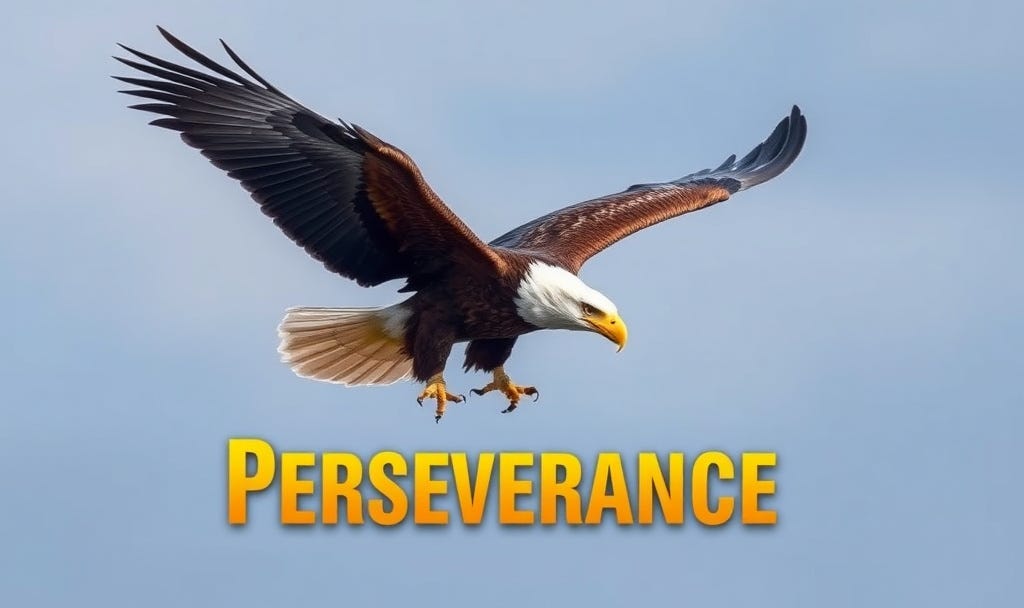
All I ever controlled was what I put in, and I had put in everything. The outcome was never mine. Do your best. Let go of the rest. It sounds like one of those Successories posters from the mall, circa 1996, the eagle soaring over the word PERSEVERANCE. But then you exhaust every counterargument you have, and the poster turns out to be right. Delivery two.
The third delivery took the longest, and it found me near the end of the week, sitting alone in the same pavilion where, days later, the shaman would say her four words. And what came through was the hardest one: trust. It’s the one I’m still working on.
Here’s what trust was up against. For as long as I could remember, my safety had one source: me. My vigilance, my preparation, my ability to see the problem coming from three moves away. Nobody catches you. I caught myself. That belief had built my whole career, and it had a perfect record, because every time something worked out, I could point to the work I’d done to make it. Trust wasn’t something I’d forgotten to try. It was the opposite of how I’d survived.
So my first instinct was to call the retreat luck. But on a solo walk through the property, I ran an audit, and I couldn’t take credit for any of it. A friend of a friend making a connection. A spot that opened up on its own. A retreat that was fully covered. Even the flight had cost me nothing but miles, banked in my years on the corporate ladder. The old life had quietly paid the airfare to the week that would carry me into the next version of myself.
I can’t prove the universe was taking care of me, and I can’t prove the surrender caused anything that came after. A skeptic would say I was counting the hits and ignoring the misses. A fair one would add that my fall had a cushion: years of shiny-company paychecks turned into savings, a network built over two decades, the exit that gave me the standing to take a break at all. True, all of it. The old life didn’t just pay the airfare. It funded the entire fall.
But I had just spent fourteen months living the opposite hypothesis, the one where nothing catches you and everything depends on your force. I had run that experiment all the way to the end. It produced nine rejections and a body stuck on tiger alert. The trust hypothesis didn’t need to be provable. It needed to be livable, and I had exhausted the alternative. So trust stopped being a claim I had to defend and became a bet I was finally willing to place. The retreat was a gift, and not one everyone gets. The bet itself costs nothing: stop forcing, be findable. The right thing would appear when I was ready. Delivery three.
Then I flew home, and home was exactly where I’d left it. The same kitchen where those four words used to make me seethe. The same bills. Every condition that had built the hum was still there, waiting to restart it.
It didn’t restart.
Instead, I did the opposite of everything I’d been doing. I stopped the exploratory chats. I stopped pounding on doors. The spreadsheet where I’d tracked every recruiter and every process stayed closed. When a plausible role came along in January, good title, good company, wrong everything else, I typed a two-line no-thank-you, the kind of email fourteen months of scarcity had convinced me I wasn’t allowed to send. No panic followed. That’s how I knew something had changed.
I also stopped going through it alone. I joined a group of business school classmates in the same boat. It found me no job. It fixed something better: I stopped feeling like the only one. Most executive searches, I learned, take the better part of a year, often longer in a tough market. Fourteen months wasn’t a verdict. It was barely above average.
I didn’t surrender everything, though. That same winter, I was fighting a loved one’s medical crisis with everything I had. Scheduling forty appointments. Politely terrorizing receptionists for earlier slots. Slipping nurses Amazon gift cards inside heartfelt thank-you notes. And it worked. The health scare resolved through vigilance and industrial-grade Type A behavior. The interview panels passed on these qualities, but those same qualities made me exactly the person you’d want running your medical crisis.
It took me the whole year to see the pattern. Some problems are spreadsheet problems. They reward force, follow-up, conditional formatting. And some problems are surrender problems. They punish force. The harder you push, the more closed they get. I’d spent fourteen months confusing the two. The career question was never a pipeline to manage. It was a door I had to stop kicking so it could open on its own.
Then, months later, it did.
One Tuesday morning, I was scrolling and saw a role at a company I’d known about for years. And my body did something before my mind caught up. A small lift in my chest.
I’d forgotten that feeling existed. For the last year, I had done the opposite: read a description, figured out who they were looking for, and quietly begun folding myself into her. Rounding down my ambitions here, inflating my enthusiasm there. Somewhere along the way, I’d stopped asking whether I wanted the job and started asking only whether I could become it.
This was different. I read the description and thought, without negotiating with myself: this is what I want, and I’m good enough for it. Not a box to fold into. A fit.
No recruiter. No backdoor, no referral. I applied on LinkedIn, the thing everyone tells you never works, and closed the laptop.
That was the job. It didn’t happen overnight and it wasn’t on my timeline. The process took five months, slow enough that the old me would have called it dead and started forcing something else. The trust I’d found on that island got tested weekly. But the role I’d spent more than a year hunting showed up only after I stopped hunting it. It was that unceremonious.
I took this break to answer one question: what I wanted to do with my life. Here’s what I know now. I’ll be asking it forever. We all will. It doesn’t get answered. Only the next step does. And that’s enough.
The spreadsheet is still in its folder. The question is still open.
It turns out both of those things are fine. Nobody warns you about that either.
The Practice
The sorting question. Next time you’re stuck, ask: is this a spreadsheet problem or a surrender problem? One test: does effort move it? If there’s a call to make, an appointment to book, a receptionist to politely terrorize, make the call. But if you’ve made every call twice and the door hasn’t budged, you may be prying at a surrender problem. Sort first. Then pick up the right instrument.
The Shelf
The Wisdom of Insecurity, Alan Watts. Written in 1951, and it reads like he spent my sabbatical taking notes. His argument is that chasing security is what creates the feeling of insecurity, that the grasping and the anxiety are one motion, not cause and cure. It took me fourteen months and a tin roof in the rain to learn what he put in a hundred pages. Start with chapter one and see how far you get before you feel personally described.
The Invitation
What’s the thing you’re currently forcing? The door you keep kicking, the search you keep running, the conversation you keep having, expecting a different answer. Name it in the comments or hit reply. Then ask yourself the sorting question. I read every one.
Made it this far? Tap the ❤️ so I know it landed. And forward this to someone who’s tired of kicking a door.
This reminds me of The Surrender Experiment by Michael A. Singer. Having left cushy jobs in corporates, surrendering to the higher power, and simply trusting the process while seeing your peers excel in their careers while you seem to stagnate, are things that I still have much to work on.
This hit on many levels. So well written too, Nathalie. Beautiful.